

Book Summary
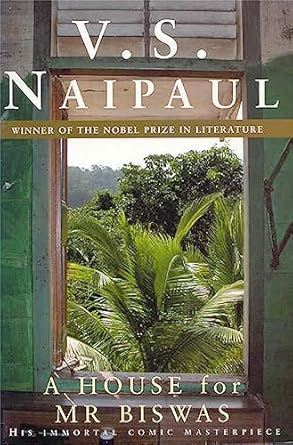
A House for Mr Biswas is a poignant and richly detailed novel that follows the life of Mohun Biswas, an Indian man in colonial Trinidad, as he struggles to assert his independence and dignity. Born under difficult circumstances and deemed unlucky from birth, Mr. Biswas endures a series of jobs, family obligations, and personal disappointments. His greatest desire is to own a house—a symbol of autonomy and self-worth. Through humor, pathos, and social critique, Naipaul paints a powerful portrait of postcolonial identity, cultural displacement, and one man’s lifelong pursuit of belonging. The novel is both an intimate character study and a broader commentary on colonial society and the immigrant experience.
About the Author –
Vidiadhar Surajprasad Naipaul (1932–2018) was a British-Trinidadian author of Indian descent and one of the most acclaimed writers of the 20th century. Born in Trinidad, he moved to England to study at Oxford and later became known for his incisive novels and travel writings that explored themes of colonialism, identity, displacement, and the legacy of empire. A House for Mr Biswas, based partly on his father's life, is considered his masterpiece. Naipaul received numerous awards, including the Booker Prize in 1971 and the Nobel Prize in Literature in 2001. Though his work often stirred controversy for its unflinching portrayals and sharp critiques, his literary influence remains profound.
![The Science of Getting Rich, The Science of Being Well and The Science of Being Great [Trilogy Set of 3 Books] by Wallace D. Wattles [Premium Books]](http://clappingpages.com/cdn/shop/files/walla.jpg?v=1767779540&width=533)


![How to Develop Self-Confidence & Influence People by Dale Carnegie: Wilco Classics Sprayed Edge Premium Hardback Edition [Premium Books]](http://clappingpages.com/cdn/shop/files/sw_027cda9f-51fa-4f99-aa19-7f50da20f275.jpg?v=1767175433&width=533)

![Getting to 'I Do' by Pat Allen| Sandra Harmon [rare books]](http://clappingpages.com/cdn/shop/files/gt_9c14e8c1-6f18-4a2a-ad4e-c712d26c35a3.jpg?v=1764228426&width=533)
![Death of A Salesman by Arthur Miller [Premium Books]](http://clappingpages.com/cdn/shop/files/sale.jpg?v=1771321876&width=533)